
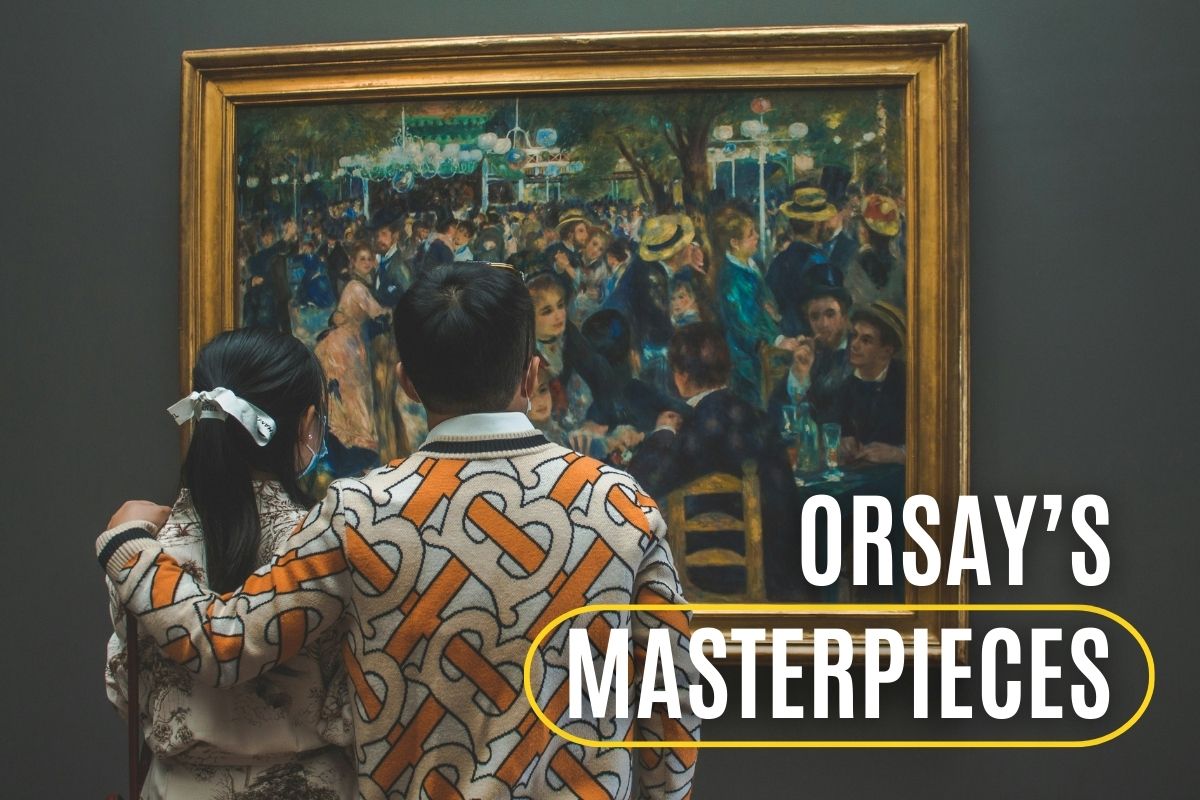
Musée d’Orsay is a must-visit on trips to Paris, especially for art and history lovers. Also known as Orsay Museum, famous paintings stretch across every wall of this gallery. It’s one of the most-visited art museums in France, attracting more than a million visitors each year!
Musée d’Orsay is among the largest museums dedicated to Impressionism and Post-Impressionism. Most Musée d’Orsay paintings are dated between the mid-1800s and the early 1900s. This was the heyday of these extremely vibrant and (at the time) controversial art movements.
Many of the most famous painters of these movements, and in the history of art overall, are featured at the Orsay Museum. These include Vincent van Gogh, Claude Monet, Paul Cézanne, and many more.
If you’re planning a visit, read on to find out the 9 top famous paintings at Orsay Museum that you absolutely shouldn’t miss!
Self-Portrait, Vincent van Gogh
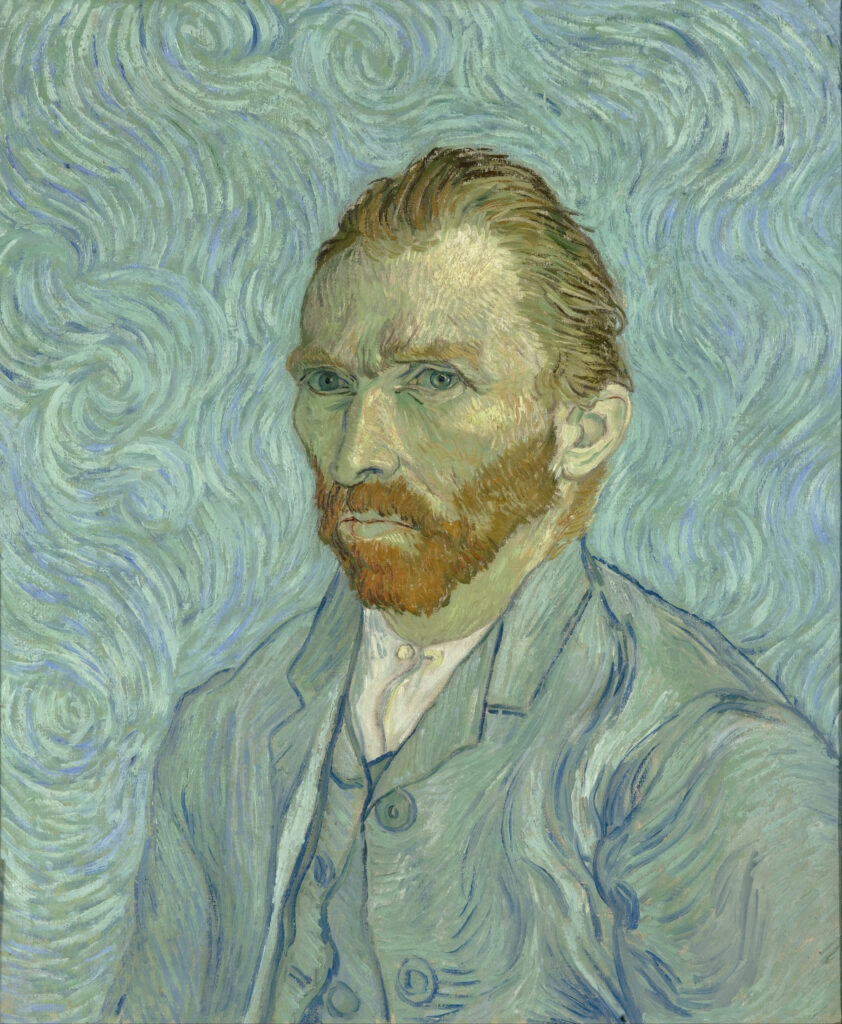
Vincent van Gogh’s many self-portraits are scattered across the globe, but two can be found in the Musée d’Orsay. They were painted in 1887 and 1889.
The 1889 self-portrait tends to be ranked among the most famous Musée d’Orsay paintings. This painting was created during a very difficult time in his life, which is evident by how it differs from his earlier self-portraits.
Van Gogh wrote to his brother about the painting: “I hope you will notice that my facial expressions have become much calmer, although my eyes have the same insecure look as before, or so it appears to me.”
The colors are more muted than in his early portraits, with soft blue tones dominating instead of warm tones. The swirling blue-green background and its contrast with Van Gogh’s hardened face and bright red hair give a sense of turmoil.
Beyond its excellence as a standalone piece, Van Gogh’s 1889 self-portrait is among 20 of his works displayed at the Musée d’Orsay. Be sure to see them all; it’s interesting to see how the artist’s style developed throughout his life.
Starry Night Over The Rhône, Vincent van Gogh
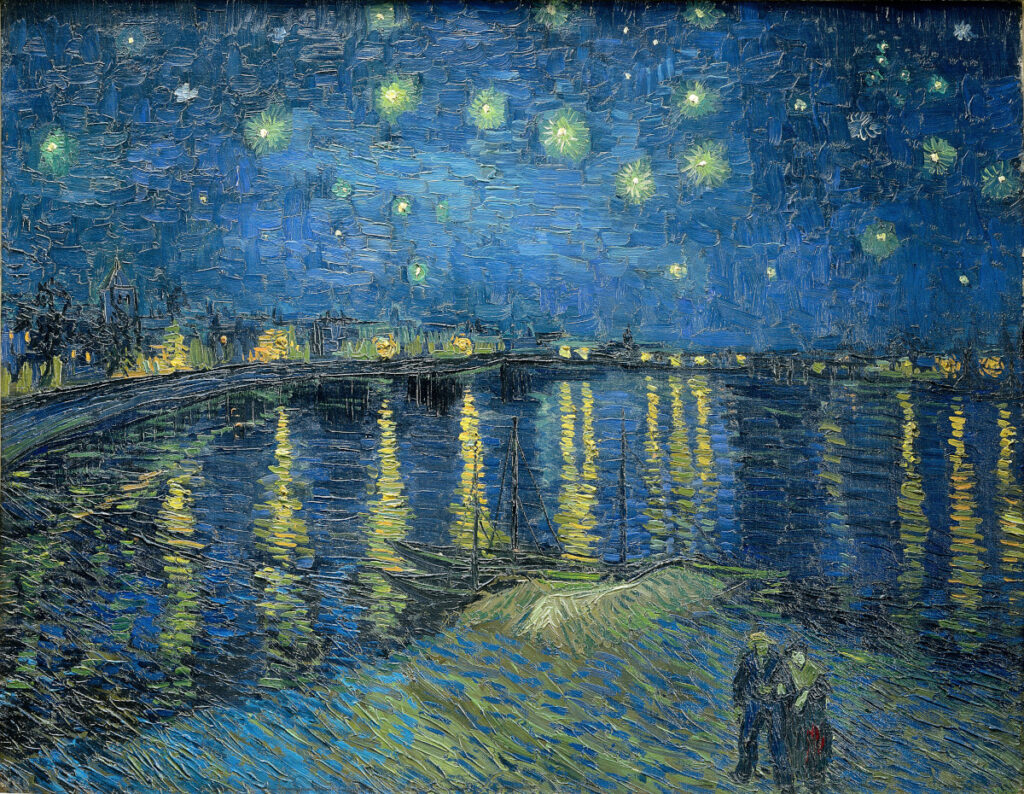
Another notable painting by Vincent van Gogh is Starry Night Over the Rhône. This 1888 piece shows a view of the Rhône near where Van Gogh was living at the time in Arles.
Even if you’ve never seen this specific painting, it definitely looks familiar. Starry Night Over the Rhône was a precursor to Van Gogh’s most famous painting: Starry Night.
Starry Night was created in 1889 shortly after Van Gosh had been committed to a mental institution. The inner turmoil is evidenced in the more aggressive brushstrokes in that version.
On the other hand, the earlier Starry Night Over the Rhône is much calmer and even features what is perhaps a couple in the bottom corner.
After moving to Arles in February 1888, he wrote to his brother, sister, and fellow painter Emile Bernard about longing to create a great painting of the starry sky.
Finally, in September of that year, he created the first of a few paintings to feature this starry sky: the one displayed right here among Van Gogh’s Orsay Museum paintings.
Poppies, Claude Monet
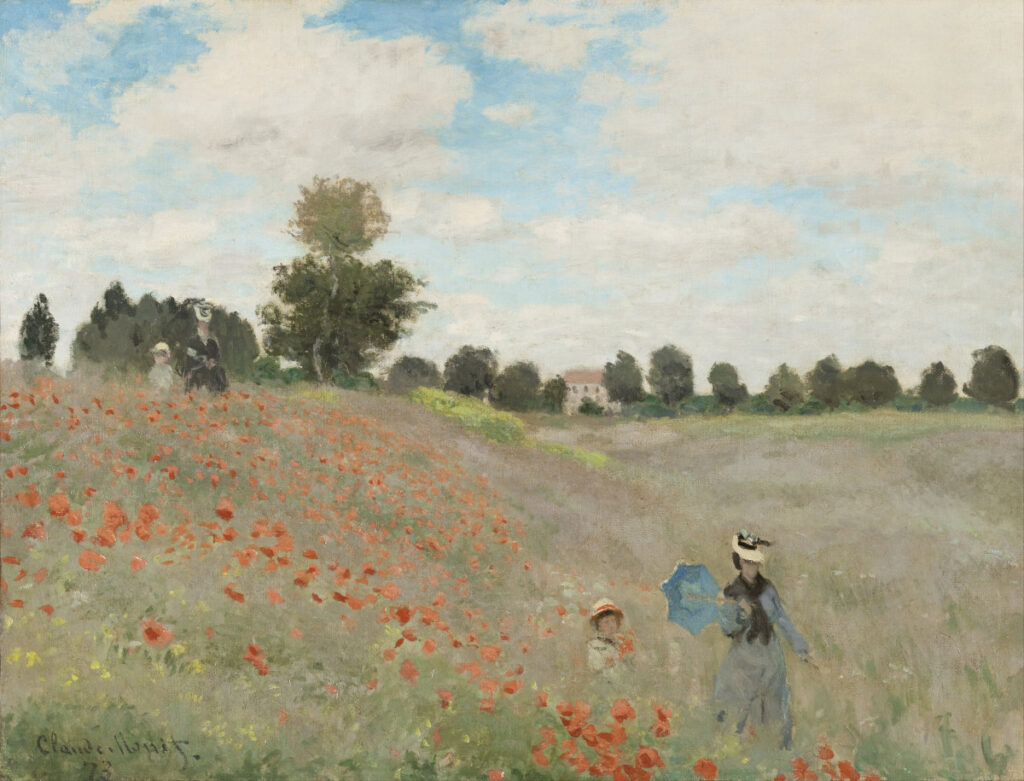
Poppies, also known as Poppy Field, is a whimsical painting by one of the founders and most influential figures of Impressionism: Claude Monet.
Monet painted scenes with poppies very often, including in this 1873 painting. During this time, Monet lived in Argenteuil, where he enjoyed “plein-air painting,” creating paintings from start to finish in the field, rather than in a studio.
The canvas of Coquelicots is divided evenly into two zones: a bright blue, cloudy sky and a tall grass meadow filled with bright red poppies. There is an abstract touch to the painting, as the poppies are disproportionate to the rest of the image.
A mother and child walk in the foreground, possibly Monet’s wife and son. There is another pair another pair behind them, forming a satisfying diagonal line (which the poppies also align with).
All of the choices Monet made were very intentional and come together to create a painting that is incredibly rhythmical and aesthetically pleasing. It has become one of the most famous paintings of the Impressionist movement.
The Card Players, Paul Cézanne
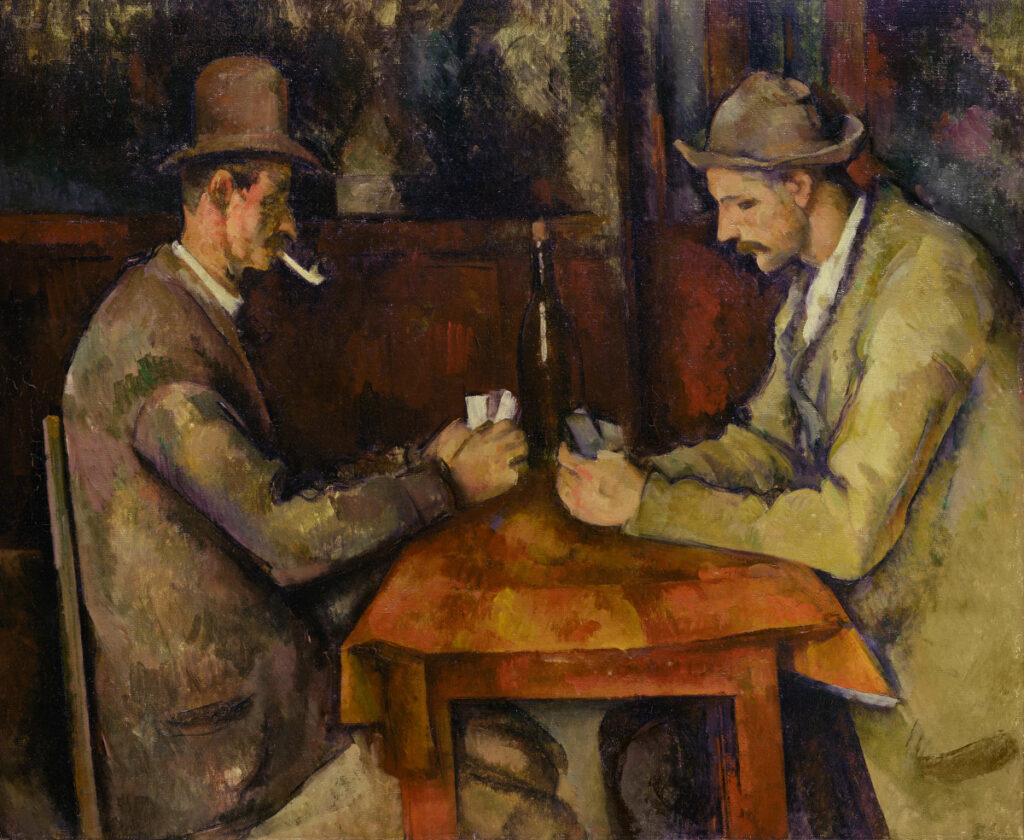
Between 1890 and 1985, the Post-Impressionist painter Paul Cézanne created five paintings with the same title: The Card Players.
The version of The Card Players that is found in the Orsay Museum is the final entry in the series. It is believed to feature two commoners that Cézanne saw around his father’s property.
In this version, you get the sense of a natural opposition between the two men playing a card game together. Not only are they opponents in the game, they are complete opposites overall.
The one on the left is older, wearing darker and more formal clothes, sitting upright, and smoking a pipe. The man on the right seems younger, wearing a lighter and more loose-fitting outfit, and his body is angled towards the table. Even their cards are different colors!
An interesting choice that Paul Cézanne made was making the composition off-center but still establishing a clear symmetry with the wine bottle in the middle of the painting.
Bal du Moulin de la Galette, Pierre-Auguste Renoir
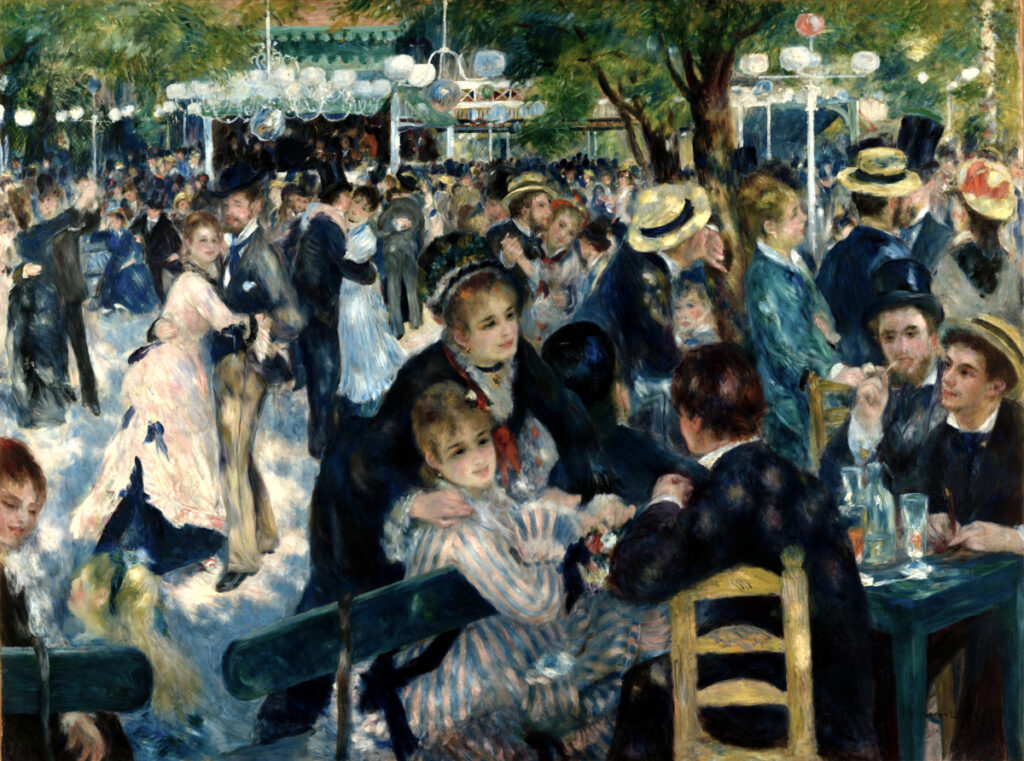
Pierre-Auguste Renoir’s 1876 masterpiece Bal du Moulin de la Galette made waves with critics upon being first shown. Now, the piece is seen as one of the defining paintings of Impressionism in the 1870s and one of the most famous French paintings of all time.
Some critics disliked the “blurriness” of the scene — a common criticism of Impressionism. Others (including many contemporary critics) greatly appreciate the lively and joyful brushstrokes Renoir used. It was quite innovative and ambitious for the time!
The painting, titled ‘Dance at Le Moulin de la Galette’ in English, depicts working-class Parisians enjoying a leisurely afternoon of dancing and drinks at the Moulin de la Galette in Paris.
The movement of the crowd and mix of natural and artificial light create a piece that feels very alive — you can feel the joy through the painting! It makes sense why this is among the top Musée d’Orsay famous paintings.
Olympia, Édouard Manet
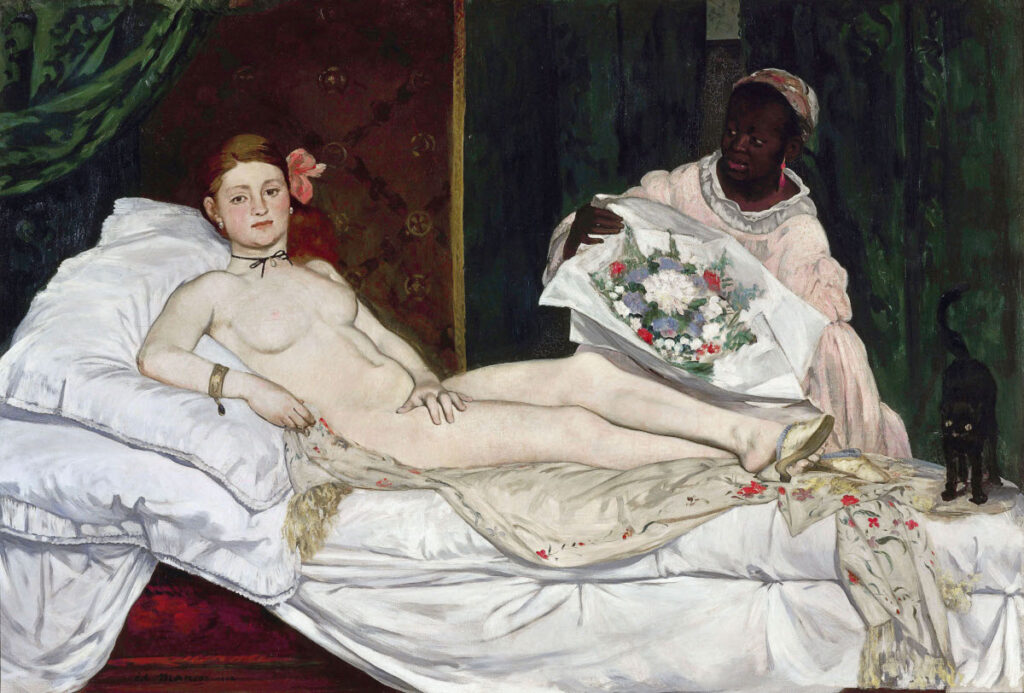
A painting that caused much more uproar was Olympia by Édouard Manet. This oil painting was created in 1863 and shown at the Paris Salon (the biggest art event in France) in 1865.
Nudity in art was not necessarily seen as crude at the time. There was no scandal over the painting Manet was inspired by (Titian’s 1538 ‘Venus of Urbino’) since the subject was a classical figure.
What caused uproar was who the subject was and the context in which she was presented. The nude model was depicted as not just a modern woman, but very likely a prostitute.
This is assumed based on several details, such as the orchid in her hair, the single slipper she wears, and even her name (Olympia was a stereotypical name for a prostitute in Paris at the time). Beyond this, the model’s gaze toward the viewer positions us as her client.
Olympia is probably one of the most controversial Orsay Museum paintings! Contemporary audiences and critics were outraged, but the boldness and artistic skill displayed by Manet in Olympia have grown to become widely acclaimed in the modern day.
The Floor Scrapers, Gustave Caillebotte
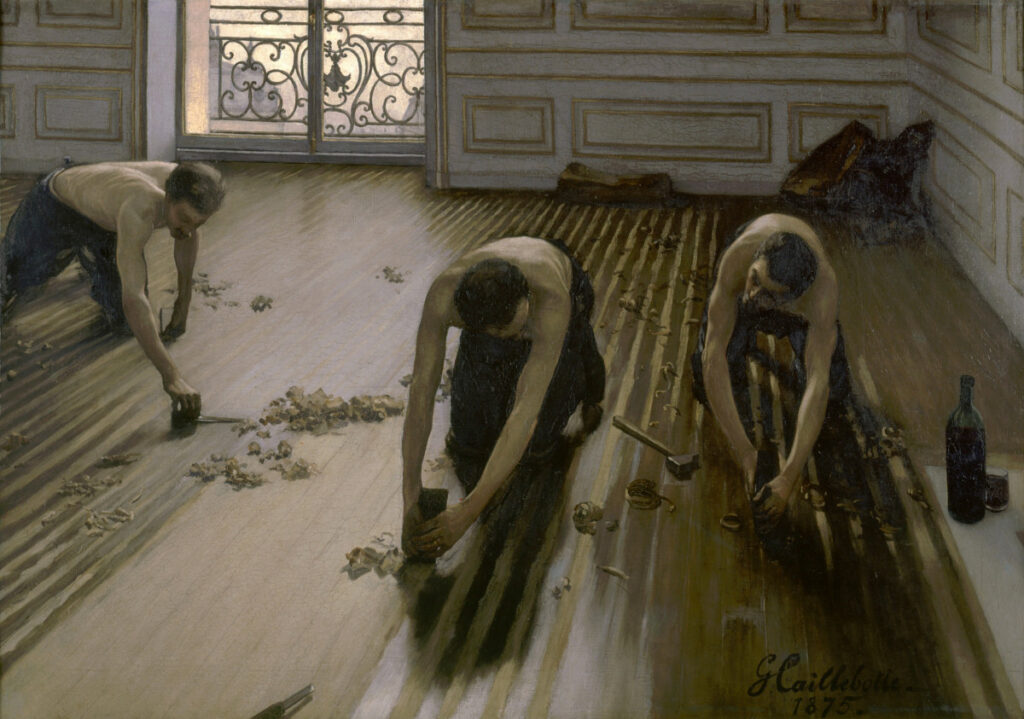
By 1875, paintings of rural peasants were common enough. On the other hand, Caillebotte was one of the first to depict urban workers in his painting, The Floor Scrapers.
When shown at the Salon, France’s biggest art event, critics were repulsed by how “crude” and “mundane” the subject matter was.
Caillebotte then opted to bring his painting to Impressionist shows. He found much more support there. His deviance in terms of subject matter, use of color, and perspective was appreciated more, though his detail and realism were not always popular in the space.
Caillebotte’s dedication to realism came from his classical training as an artist. He was very academically inclined in his paintings. One aspect of the painting that speaks to his academic background is that the workers are painted with sculpted torsos typical of classical Heroes.
This is a painting that you really should see in person. The closer you look, the more Caillebotte’s subtle creativity shines through, even compared to the other amazing Musée d’Orsay paintings.
Arearea, Paul Gauguin
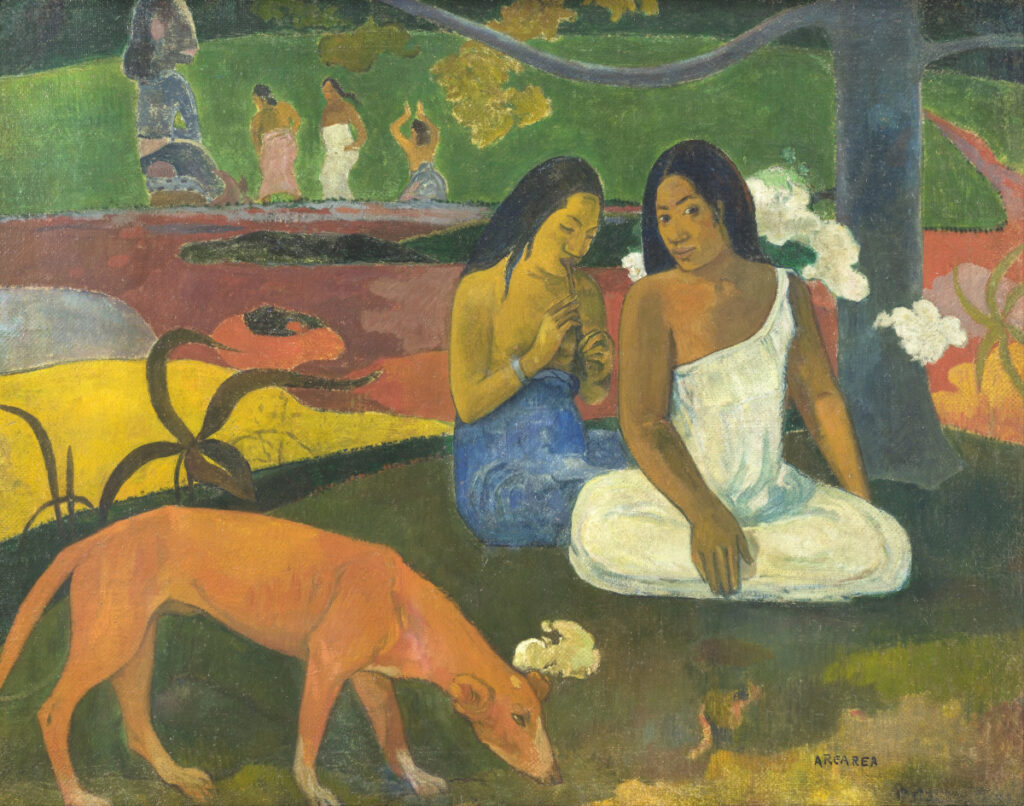
Paul Gauguin was one of the leading artists of Synthetism. This is a Post-Impressionism art movement that was distinct from Impressionism due to its focus on flat, two-dimensional patterns.
One piece that really exemplifies this style is the 1892 painting titled Arearea. It was one of many paintings inspired by Gauguin’s time in Tahiti.
Gauguin was enthralled by everything about Tahiti: the people, the culture, the traditions, the folklore, and more.
Arearea depicts an idealized version of Tahiti that is in stark difference to his French reality, featuring languid women, a free-roaming dog, and a scene of island worship in the background.
Gauguin was especially fond of his Tahitian paintings, especially Arearea. He actually bought it back for himself after selling it.
Unfortunately, the paintings were not as well-received as he would have liked at the time. Now, however, his paintings like Arearea have joined the ranks of the top Orsay Museum paintings.
London Houses of Parliament, Claude Monet
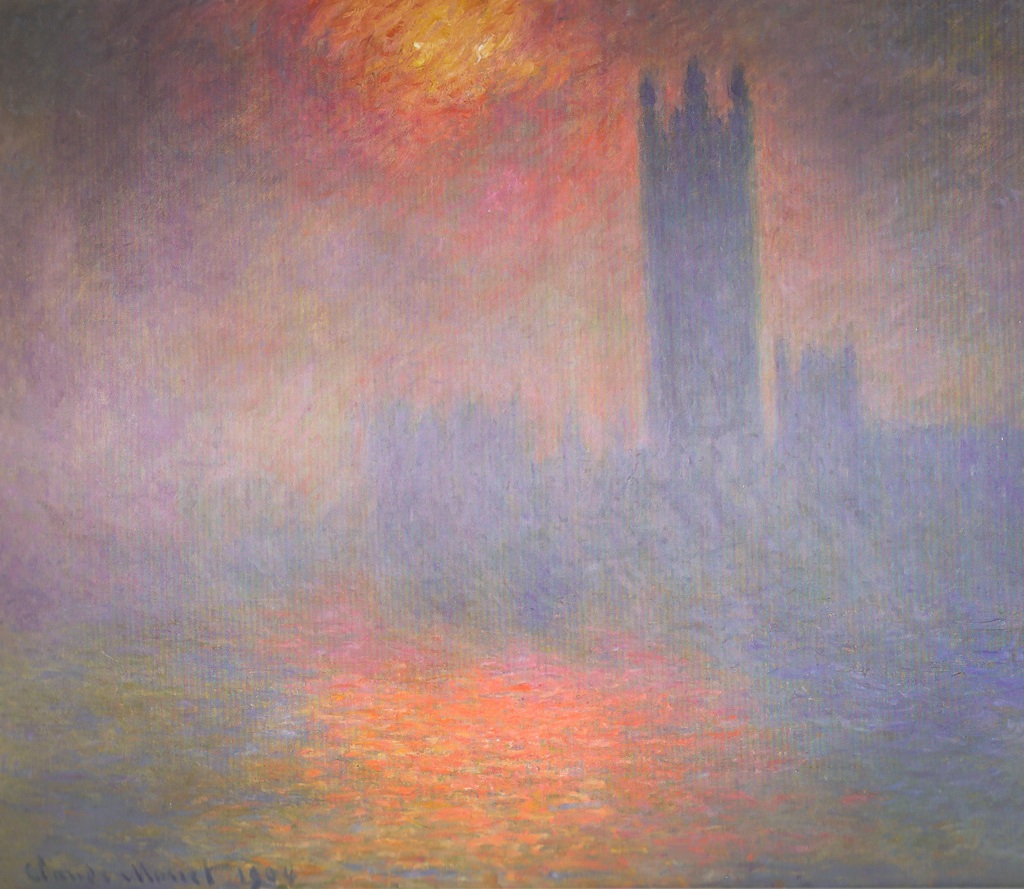
The River Thames was one of Claude Monet’s favorite subjects. He made more than 100 paintings featuring it!
Several of these pieces are painted from a certain viewpoint that includes the Houses of Parliament in London. The only things that differ between them are the time of day and the weather.
In the Musée d’Orsay painting, which was created in 1904, the London fog envelopes the scene, creating a hazy blur.
Thanks to the fog, the sky and river almost blend into one. They are painted in the same tones of blue, orange, and mauve, but are distinguished by the difference in texture.
The Victoria Tower of the Houses of Parliament looms in the background like a ghost, almost as formless as the sky and the river.
Monet’s use of color and clever decisions — such as using broad brushstrokes to depict how dense the fog is — make this painting a must-see while at the Musée d’Orsay.